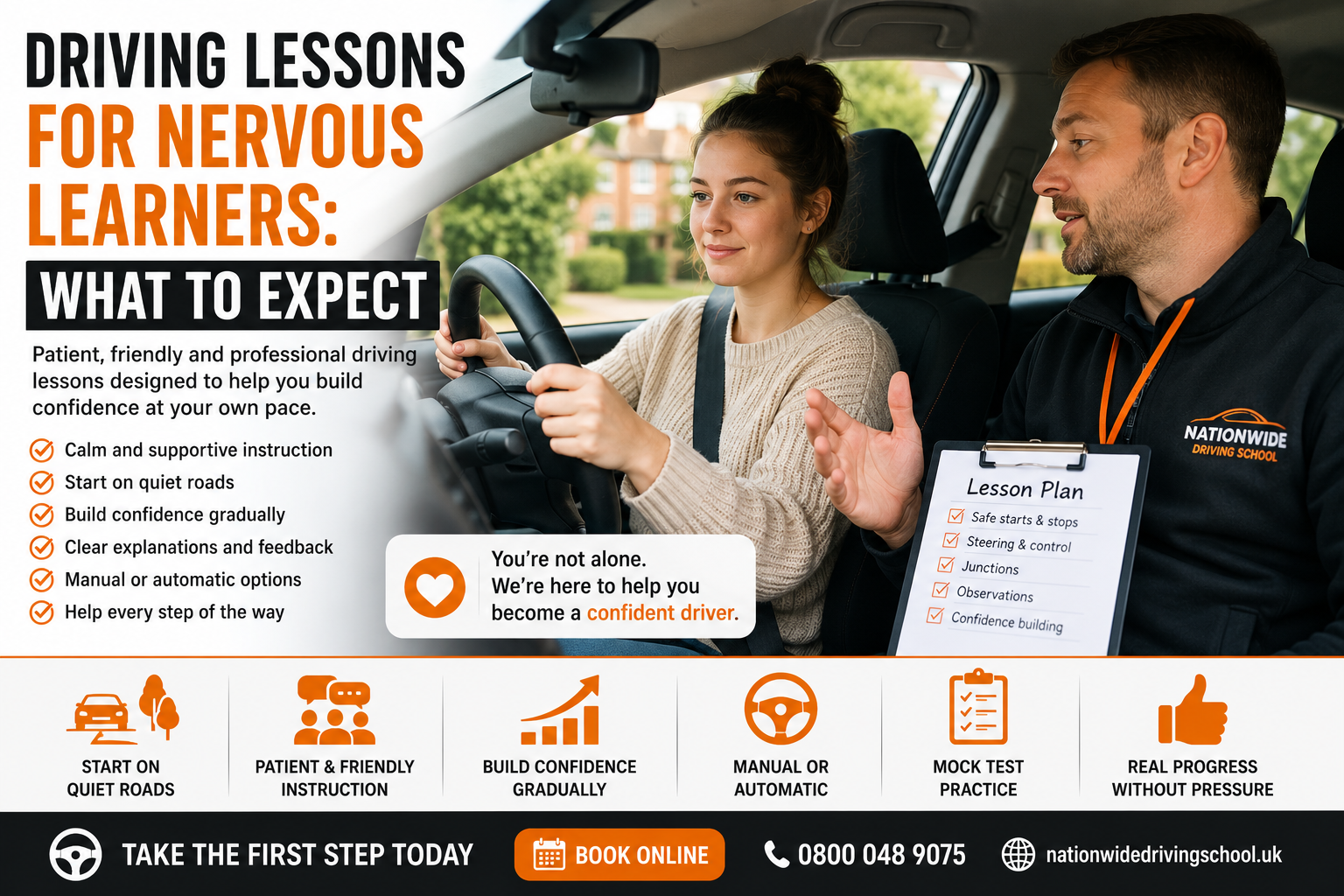
Driving Lessons for Nervous Learners: What to Expect
Feeling nervous before a driving lesson is common. Some learners worry about making mistakes, controlling the car, meeting traffic or driving on busy roads.
Others may have lost confidence after a previous bad experience, an unsuccessful practical test or a long break from driving.
Patient, structured driving lessons can help you develop confidence gradually without rushing through important skills.
Nervousness does not mean that you cannot become a safe and confident driver. In many cases, anxiety improves when the learner understands what will happen during the lesson and feels able to progress at a suitable pace.
A good instructor should explain tasks clearly, give constructive feedback and introduce more demanding roads only when the learner is ready.
Why Do Learners Feel Nervous About Driving?
Different learners feel nervous for different reasons. Therefore, it is helpful to identify what is causing the anxiety before deciding how lessons should be structured.
Common concerns include:
- Fear of making mistakes
- Worry about stalling a manual car
- Difficulty judging speed or distance
- Nervousness around roundabouts
- Concern about other drivers
- Previous criticism from an instructor or family member
- An unsuccessful practical test
- A long break from driving
- Busy traffic or unfamiliar roads
- Fear of holding up vehicles behind
Once the instructor understands the main concern, the lesson can focus on building the learner’s control and confidence in that area.
What Happens During the First Lesson?
The first driving lesson should not feel like a test. Instead, it should introduce you to the car, the instructor and the basic lesson structure.
Depending on your experience, the first session may include:
- Checking your provisional driving licence
- Adjusting the seat and mirrors
- Learning the main vehicle controls
- Understanding basic safety checks
- Discussing your previous experience
- Explaining how lessons may progress
- Practising moving away and stopping
- Driving on a quiet road
Complete beginners may spend part of the lesson understanding the controls before driving further. However, partly trained learners may begin with a short assessment so the instructor can understand their current standard.
Starting on Quieter Roads
Many nervous learners benefit from starting in a quieter area with less traffic and fewer distractions.
This can provide more time to practise:
- Steering
- Moving away safely
- Stopping smoothly
- Mirror checks
- Clutch control in a manual car
- Basic junctions
- Road positioning
As your confidence grows, the instructor can gradually introduce busier roads, larger junctions, roundabouts and faster traffic.
However, lessons should not remain on quiet roads forever. Progress involves applying the same skills in more realistic driving situations when you are ready.
How Confidence Is Built Gradually
Confidence usually develops through repeated safe practice rather than being told simply to relax.
A structured approach may involve:
- Explaining the skill before attempting it.
- Demonstrating the task where appropriate.
- Practising with instructor support.
- Repeating the skill until it becomes more familiar.
- Reducing prompts as the learner improves.
- Using the skill independently in different situations.
For example, a nervous learner may first practise roundabouts at quieter times. Afterwards, the instructor can introduce busier approaches and more complex lane choices.
Clear Instructions and Feedback
Nervous learners often benefit from calm, specific instructions.
Rather than giving several directions at once, an instructor may break a task into smaller stages. This can make the situation feel more manageable.
Helpful feedback should explain:
- What went well
- What needs improvement
- Why the change is important
- How to correct the issue next time
- What will be practised in the next lesson
Constructive feedback is different from criticism. The aim is to help the learner understand the driving task and improve safely.
Manual or Automatic Lessons for Nervous Learners?
Both manual and automatic lessons can suit nervous learners. The best choice depends on the learner’s preferences, confidence and future driving plans.
Manual Driving Lessons
Manual learners must coordinate the clutch, accelerator, brake and gears while continuing to observe and plan ahead.
Some learners enjoy developing these skills and want the flexibility of a manual licence.
However, nervous learners may need extra time to become comfortable with clutch control, hill starts and gear changes.
Automatic Driving Lessons
Automatic cars do not require manual gear changes or clutch control.
Therefore, some nervous learners find it easier to focus on steering, observations, road position and decision-making.
Nevertheless, automatic driving still requires safe judgement, planning and independent control. It does not guarantee that the learner will need fewer lessons or pass more quickly.
Licence reminder:Passing in an automatic vehicle normally limits the driver to automatic vehicles. Passing in a manual car normally allows the licence holder to drive manual and automatic cars, subject to the categories granted.
Changing Instructors After a Bad Experience
Some learners become nervous because of a previous lesson experience.
You may consider changing instructors if you regularly feel:
- Rushed
- Ignored
- Unclear about your progress
- Uncomfortable asking questions
- More anxious after every lesson
- Unable to understand the teaching method
However, changing instructors does not always mean that previous tuition was wasted. Many skills can transfer to the new instructor and vehicle.
When beginning with someone new, explain:
- How many lessons you have completed
- Which skills you have practised
- What makes you feel most nervous
- Whether you have taken a practical test before
- What teaching style helps you learn
The new instructor may then complete an assessment and build a suitable training plan.
Returning to Driving After a Long Break
A long break can reduce confidence even when the learner previously made good progress.
Initially, the instructor may revisit:
- Vehicle controls
- Moving away and stopping
- Mirror routines
- Junctions
- Roundabouts
- Meeting traffic
- Parking manoeuvres
As confidence returns, lessons can move towards more independent driving and unfamiliar roads.
Nervousness After an Unsuccessful Test
An unsuccessful practical test can affect confidence, especially when the learner had expected to pass.
However, a failed test does not mean that you are incapable of driving safely.
The next lessons should review:
- The faults recorded during the test
- Whether the faults were repeated or isolated
- How nerves affected decision-making
- Which skills need more consistent practice
- Whether more mock-test-style training would help
It can also be useful to practise recovering calmly after a mistake. One error during a lesson should not cause the learner to lose concentration for the rest of the drive.
Mock-Test-Style Lessons
Mock-test-style lessons may be useful when a learner is approaching test standard.
During this type of session, the instructor may give fewer prompts and observe how the learner drives independently.
The lesson can help identify:
- Repeated observation faults
- Late decisions
- Lane-position problems
- Speed-control issues
- Roundabout difficulties
- Parking weaknesses
- How the learner responds under pressure
However, a mock lesson is not a guaranteed prediction of the official test result. Additional training may still be recommended.
Managing Nerves Before a Lesson
Simple preparation can make a lesson feel more manageable.
Before the session:
- Get enough rest
- Wear suitable footwear
- Avoid rushing to the collection point
- Bring any required glasses or contact lenses
- Tell the instructor if you are particularly anxious
- Ask what the lesson will cover
Try not to compare your progress with friends or family members. Learners develop at different speeds, and the number of lessons taken by someone else does not determine what you need.
Managing Nerves During the Lesson
If you begin to feel overwhelmed, tell the instructor.
The instructor may be able to:
- Pause in a safe place
- Explain the task again
- Reduce the difficulty temporarily
- Break the task into smaller steps
- Repeat the exercise on a quieter road
It is better to communicate than to continue while feeling unable to concentrate.
How Regular Lessons Can Help
Regular lessons may help nervous learners maintain familiarity with the car and reduce the need to rebuild confidence after long gaps.
Long breaks can lead to:
- Forgotten routines
- Reduced confidence
- More time spent revisiting previous skills
- Slower progress
Therefore, choose a lesson schedule that you can attend consistently.
Do Nervous Learners Need More Lessons?
Not necessarily. Nervousness affects people differently.
Some learners become confident quickly once they understand the car and lesson structure. Others need more repetition before they feel comfortable driving independently.
The number of lessons required depends on:
- Previous experience
- Lesson frequency
- Manual or automatic tuition
- Ability to retain information
- Observation and planning skills
- Private practice, where available
- Confidence in different road conditions
For this reason, no responsible instructor should promise that every nervous learner will be ready within a fixed number of hours.
Learning in Burton upon Trent
Burton upon Trent offers a mixture of residential roads, town traffic, roundabouts and faster routes.
Nervous learners may begin in quieter areas before progressing to more demanding traffic and independent driving.
Read more about driving lessons and instructors in Burton upon Trent.
Learning in Derby
Derby provides experience of urban roads, residential areas, busy junctions and multi-lane roundabouts.
Lessons can be structured around the learner’s confidence and current ability.
View our manual driving lessons in Derby page.
Learning in Uttoxeter
Uttoxeter includes residential roads, town-centre driving, rural routes and access to faster roads near the A50.
This variety can help nervous learners build confidence gradually across different road environments.
Visit our driving lessons in Uttoxeter page.
What to Look for in a Patient Driving Instructor
A patient instructor should still provide honest feedback and help the learner progress.
Look for someone who:
- Explains tasks clearly
- Allows questions
- Gives calm feedback
- Adapts the lesson where appropriate
- Does not make unrealistic promises
- Discusses progress honestly
- Introduces new situations gradually
- Keeps the lesson professional and focused
Pupils may be taught by DVSA-approved driving instructors or DVSA-licensed trainee driving instructors, where applicable. All instructors providing paid tuition are authorised to do so.
Questions to Ask Before Booking
- Do you provide lessons for nervous learners?
- Can the first lesson begin on a quieter road?
- Do you offer manual or automatic tuition?
- Does the instructor cover my postcode?
- When could lessons begin?
- Can I book regular weekly lessons?
- How will my progress be monitored?
- What is the cancellation policy?
- Can I change instructors if the teaching style is not suitable?
- Do you provide mock-test-style lessons when I am ready?
Frequently Asked Questions
Is it normal to feel nervous before driving lessons?
Yes. Many learners feel anxious before their first lesson or when facing new road situations. Confidence usually develops through clear explanations and repeated safe practice.
Can I start my lesson on a quiet road?
Where appropriate, the instructor may begin in a quieter area. As your confidence improves, lessons should gradually include more demanding roads and traffic.
Should nervous learners choose an automatic car?
Automatic tuition may suit learners who find clutch control and gear changes stressful. However, the best choice depends on your preferences and future driving plans.
What if I have had a bad experience with another instructor?
Explain the previous experience and what made you uncomfortable. A new instructor can assess your current ability and discuss a more suitable lesson approach.
Can I take a break during the lesson?
If you feel overwhelmed, tell the instructor. Where safe and practical, the lesson may pause so the task can be explained again.
Do mock tests help with nerves?
Mock-test-style lessons can help learners become familiar with driving more independently. However, they do not guarantee an official practical-test pass.
How many lessons will a nervous learner need?
There is no fixed number. The amount of training depends on experience, lesson frequency, confidence and overall driving ability.
Can I change instructors?
You may request a change, subject to another suitable instructor being available in your area.
Book Driving Lessons for Nervous Learners
Build your confidence through calm, structured driving tuition planned around your current experience and ability.
Nationwide Driving School accepts enquiries from nervous beginners, partly trained learners, returning drivers and pupils preparing for a practical test, subject to instructor availability.
Related Nationwide Driving School Links
- Driving lessons in Burton upon Trent
- Manual driving lessons in Derby
- Driving lessons in Uttoxeter
- How to choose a reliable driving school
- Which driving lesson package offers the best value?
- Driving lesson prices and block bookings
- Current beginner offers
- Theory Test Pro
- Customer reviews
- Book driving lessons online