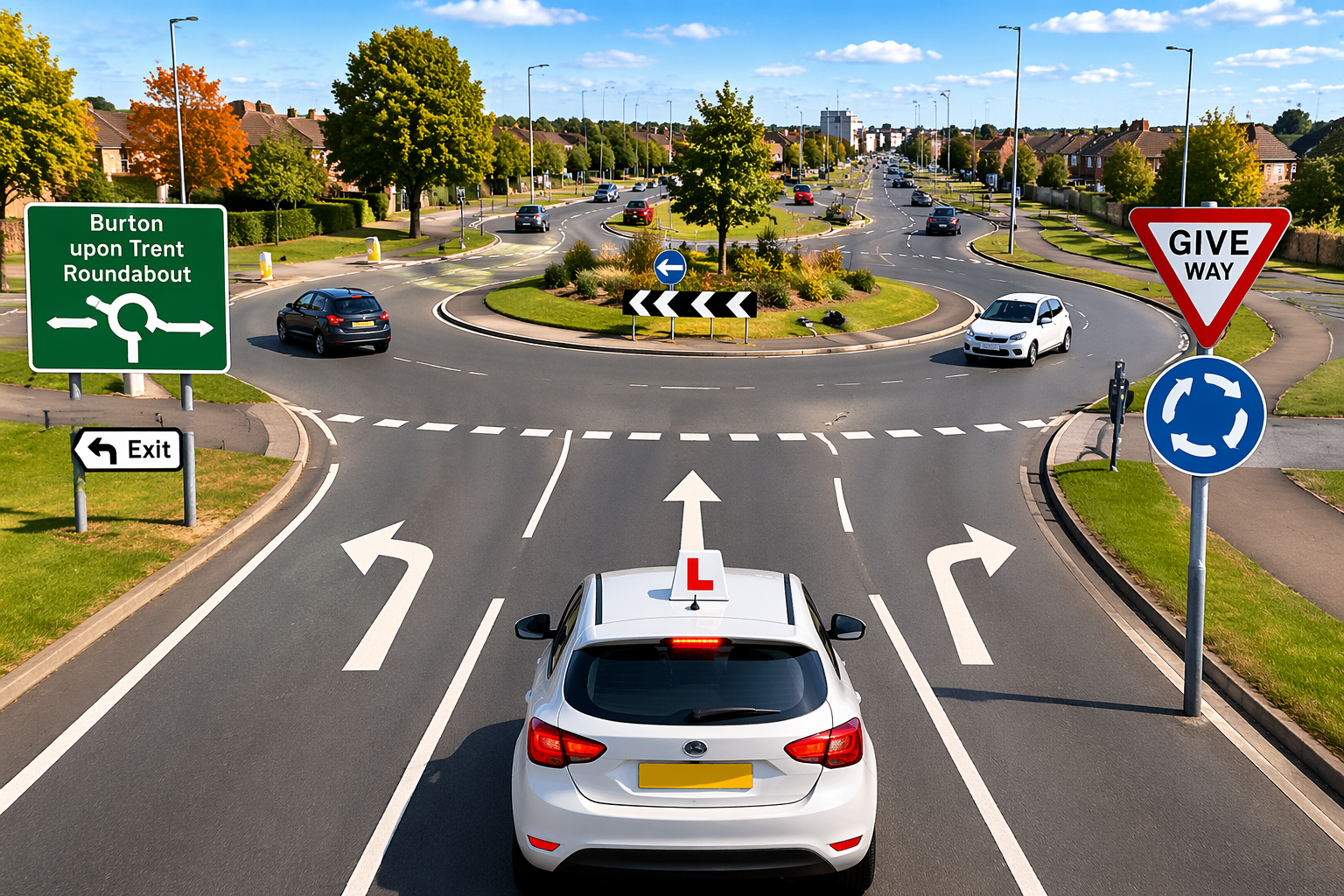
How to Do Burton Roundabouts and the Common Mistakes Pupils Make
Roundabouts
can feel like one of the biggest hurdles for learner drivers in Burton upon Trent, especially once traffic starts building around local routes and key junctions. A lot of pupils are perfectly capable on straight roads, on quieter estate roads, and even at simple junctions, but confidence can suddenly drop as soon as a roundabout appears ahead. That reaction is normal. Burton has a road network that connects local town traffic with larger routes, including the A38, A444, A511, A5121 and A5189, and St Peter’s Bridge is a major local crossing, so roundabouts are a regular part of driving in and around town. Burton-on-Trent railway station is also accessed from Borough Road, which adds to the mix of busy local movements learners often need to read correctly.
The Highway Code
The good news is that roundabouts become far easier once a pupil follows a clear routine every time. The Highway Code says that on approach to a roundabout, a driver should use Mirrors, Signal, Manoeuvre, decide as early as possible which exit is needed, move into the correct lane, adjust speed, and stay aware of the position and speed of surrounding traffic. At the roundabout itself, the Code says to give priority to traffic from the right unless signs, road markings or traffic lights say otherwise. It also explains that lane choice and signalling depend on whether the driver is taking the first exit, an intermediate exit, or a right turn.
In Burton upon Trent, that routine matters because local learners are not just dealing with one identical roundabout repeated over and over. One lesson might include a compact mini-roundabout in a quieter area. Another might involve a larger, busier layout where lane markings matter much earlier. A pupil who learns one dependable method can apply it across all of those different situations. That is one reason local route knowledge matters so much in driving lessons. Practising around familiar Burton roads helps a learner focus on timing, lane discipline, and observation instead of wasting attention trying to work out the area at the same time.
How to Do a Roundabout Properly in Burton upon Trent
The first step is planning early. Before the roundabout, read the road signs and lane markings as soon as possible. In Burton, traffic can build quickly on routes feeding major roads, so leaving lane choice too late often creates panic. The Highway Code is clear that drivers should notice and act on all available information, including signs, road markings and traffic lights, before reaching the roundabout.
Next comes mirrors
A pupil should check mirrors before changing speed or position. That means using the interior mirror first and then checking the relevant door mirror if the lane position is going to change. This sounds simple, yet it is one of the first things that disappears once nerves rise. If a pupil forgets mirrors, awareness of traffic behind is lost before the roundabout is even reached. The Highway Code places mirror use right at the heart of the roundabout routine.
After mirrors comes a signal
After mirrors comes a signal, but only when appropriate. For a left exit, signal left. For a right exit or full circle, signal right on approach and then signal left after passing the exit before the one you want. For many intermediate exits, the Highway Code says a driver will not normally need to signal on approach unless signs or markings say otherwise. A lot of pupils oversignal or signal too early, which can mislead other road users. Clear, timed signals matter far more than constant signals.
Position is next
If the road markings say left lane for a certain exit, follow that. If the markings direct traffic differently from the usual rule, the markings take priority. This is especially important on larger Burton roundabouts, where lane arrows and painted guidance do the hard work if a pupil reads them early enough. Poor positioning is one of the most common reasons a roundabout feels messy. A pupil who starts in the wrong lane often tries to fix the mistake too late, and that is where stress increases.
Speed control
Speed control matters just as much. A good approach is smooth and early, not a hard brake at the last moment. As the roundabout comes closer, the pupil should be ready to stop if needed, while still looking for a safe chance to go. That balance is what many learners need to practise. Going too fast reduces thinking time. Crawling too slowly when a safe gap is already there can also create problems, especially if hesitation causes confusion for traffic behind. The Highway Code advises adjusting speed and position to fit traffic conditions and looking forward before moving off to make sure traffic in front has moved.
Decision point
Then comes the decision point: look right, look ahead, and judge whether the gap is safe. In the UK, traffic on the roundabout or approaching from the right generally has priority unless signs, markings or lights direct otherwise. Once a safe gap appears, the pupil needs to move positively. Confidence does not mean rushing. It means making a clear, safe decision and carrying it through.
Once on the roundabout, stay in the chosen lane and keep scanning. Watch for poor signalling from other drivers, vehicles drifting between lanes, cyclists, and larger vehicles that may need extra space. The Highway Code specifically warns that long vehicles may straddle lanes or take a different course because of length. That matters on Burton roads too, especially where roundabouts connect with main through-routes.
Finally, as the exit approaches, check mirrors, signal left if appropriate, and steer out smoothly without cutting across another lane. Many pupils relax too early here and lose accuracy at the very last moment. A roundabout is not finished until the car is fully clear and in the correct position on the exit road.
Common Mistakes Pupils Make on Burton Roundabouts
Planning too late
One of the biggest mistakes is planning too late. A pupil sees the roundabout, feels pressure, and then starts reading signs only when almost on top of the give-way line. By then, there is barely any time left for mirrors, signal, position and speed. Early planning is what keeps everything calm.
Choosing the wrong lane
Another common mistake is choosing the wrong lane because of panic. A pupil may know the correct exit, but still drift into a lane simply because it feels easier at the last second. In Burton, where roads can feed quickly into busy junctions, that habit can lead to last-minute swerving or missing the exit entirely.
Staring only to the right
A third mistake is staring only to the right and forgetting to look ahead. Yes, the right side matters for priority, but the Highway Code also says to look forward before moving off to make sure the vehicle in front has actually moved. Some pupils focus so hard on the right that a stationary vehicle ahead is noticed too late.
Hesitating when a safe gap
Another frequent issue is hesitating when a safe gap is already there. This happens a lot with nervous learners. The pupil slows, keeps looking, sees the space, but still waits too long and misses it. After that, confidence drops more. Good lesson coaching helps a pupil recognise what a safe, usable gap really looks like.
Rushing into a gap
The opposite mistake also appears: rushing into a gap that is not safe. This often happens when a pupil feels pressure from traffic behind. Other drivers do not get to decide when it is safe to go. The correct choice is always the safe choice, not the fastest one.
Poor signalling
A very common Burton roundabout mistake is poor signalling. Some pupils signal right too early, forget to cancel it, or signal left far too soon. That can confuse drivers waiting to enter. Rule 103 of the Highway Code warns that signals should not mislead others, and roundabouts are a perfect example of why timing matters.
Cut across lanes
Many pupils also cut across lanes on the roundabout. This usually starts with poor approach position or weak steering control once nerves rise. A pupil may enter correctly, then drift toward another lane while focusing on the exit. That is why good lane discipline has to continue all the way around, not just on entry.
Approaching too fast
Another regular mistake is approaching too fast. Fast approach speed shortens thinking time and makes the give-way decision harder. It also makes steering less controlled. On mini-roundabouts, this can become even more obvious because there is less room and less time to sort things out. The Highway Code says mini-roundabouts should be approached like normal roundabouts, but with less space to manoeuvre and less time to signal. It also says vehicles must pass around the central markings unless physically incapable because of size.
Treating mini-roundabouts casually
One more mistake is treating mini-roundabouts casually. A lot of pupils see the painted circle and assume it is only a small junction. In reality, the same priorities still apply. Traffic from the right still matters, and poor observations still lead to faults. Mini-roundabouts often catch learners out because everything happens faster.
How to Improve Faster
The best way to improve on Burton roundabouts is through repeated local practice with a patient instructor. That means using routes that build from easier layouts to busier ones, correcting one habit at a time, and repeating the same routine until it starts to feel automatic. Nationwide Driving School already offers beginner packages, block booking discounts, manual and automatic lessons, and intensive courses, which makes it easier to build regular practice into a learner’s plan. The school’s site also promotes DVSA-approved or DVSA-licensed instructors, flexible lesson times and local coverage around Burton and the surrounding areas.
automatic lessons
For some pupils, automatic lessons make roundabouts easier because there is less to think about at low speed. For others, manual lessons work well once clutch control and speed control become more settled. The key point is consistency. One calm, repeated system used on every roundabout will usually beat random last-second decisions every time.
If roundabouts in Burton upon Trent are causing stress, the answer is not to avoid them. The answer is to practise them properly with clear guidance, real local routes, and enough repetition to turn nerves into confidence.
Connect With Us on Social Media
Related Links
-
-
- How to Navigate Roundabouts in Burton
- Manual Driving Lessons in Burton on Trent
- Beginner Offers
- Block Booking Discounts
- Book Driving Lessons Online
- Read Our Reviews
- Highway Code: Using the Road
- Highway Code: Road Markings
- Book Your Driving Test
- Road Safety Advice for Drivers
- Mini-Roundabouts Guidance
-